
By Greenville Catering September 18, 2026
A corporate catering standing order turns a recurring office lunch from a weekly planning exercise into a repeatable operating routine. Instead of rebuilding every Wednesday’s order from scratch, the office and caterer agree ahead of time on a normal headcount, menu structure, delivery window, weekly change deadline, dietary process, and billing method.
That does not mean your team receives exactly the same food for exactly the same number of people every week. A well-designed recurring program leaves room for headcount changes, vegetarian or vegan meals, allergy-related requests, rotating menus, skipped holiday weeks, special meetings, and occasional upgrades.
The difference is that those changes happen inside an agreed framework.
For an office feeding roughly 30 to 50 people each week, the setup might look like this: Wednesday lunch is the standing delivery day; 40 people is the baseline count; menus rotate through several formats; the office coordinator sends any changes before the agreed cutoff; special meals are tracked separately; and payment happens either through an authorized card on file or an approved business account.
Larger organizations may prefer consolidated invoicing because their AP department needs purchase orders, cost centers, approval records, or one bill covering several deliveries. Smaller companies may find weekly card payment easier.
A short trial period is often the best place to start. Two real deliveries reveal whether the delivery window, menu quantities, dietary process, building access, billing detail, and communication routine actually work before the arrangement becomes ongoing.
The goal of an office lunch catering program is not merely recurring food. It is recurring food with fewer recurring administrative problems.
Corporate Catering Standing Order: How a Weekly Lunch Program Works
A corporate catering standing order is a recurring scheduled catering arrangement built around a predictable pattern.
That pattern usually includes a regular day or days, an expected delivery period, a normal range of people, a menu framework, an agreed process for weekly changes, and a defined method for paying the caterer.
A standing order is different from simply copying last week’s order.
For example, an office might establish lunch every Wednesday at approximately noon for 35 to 45 employees. Instead of selecting an entirely new menu every Monday, the office and caterer might establish a rotating set of lunch formats—perhaps boxed lunches one week, a hot buffet the next, bowls or wraps another week, followed by another agreed menu.
The office then updates only the variables that changed.
Those variables might include:
- this week’s headcount,
- vegetarian meals,
- vegan meals,
- gluten-free requests,
- documented allergy-related needs,
- a changed meeting location,
- extra beverages,
- an earlier delivery,
- or a skipped week.
This is why recurring catering should not be treated as an inflexible subscription.
A practical standing order has stable foundations and controlled flexibility.
The right recurring lunch format depends on how employees eat, how much setup space is available, how long the lunch window lasts, and whether people need to carry meals back to desks or conference rooms.
Comparing different catering service styles for the size and format of the gathering can help an office decide whether individual meals, a buffet, or a more structured setup makes the most sense.
What should be standardized from the beginning?
At minimum, establish:
- normal lunch day,
- standing delivery window,
- baseline headcount,
- menu structure or rotation,
- service style,
- dietary-request process,
- weekly update channel,
- change cutoff,
- authorized office contacts,
- billing method,
- holiday-pause process,
- and escalation contact.
These details form the operating system for the program.
A weekly lunch can then change without becoming chaotic.
How an office lunch catering program is usually structured
An office lunch catering program does not have to mean five lunches every week.
Some offices arrange one weekly meal. Others schedule Tuesday and Thursday service. Some companies cater a recurring monthly all-hands meeting but use the same standing-order process because the operational variables repeat.
The frequency matters less than the consistency.
The office should designate one primary coordinator and, ideally, one backup. Employees can send dietary or attendance information to that person internally, but the caterer should not have to reconcile four different emails, a Slack message, two text messages, and a phone call containing different counts.
Pro Tip: Pick one person to submit the official weekly count. Multiple people sending competing updates is one of the fastest ways to create shortages, over-ordering, and invoice disputes.
Standing orders versus one-off catering
A one-time department lunch and a recurring Wednesday program may use similar food, but they are operationally different.
| Factor | One-Off Order | Standing Order |
| Scheduling | Created for one date | Recurring day or calendar |
| Menu | Selected for that event | Rotation or agreed framework |
| Headcount | One-time estimate/final count | Baseline updated regularly |
| Delivery | Coordinated separately | Standing delivery window |
| Dietary needs | Collected for one event | Maintained and updated |
| Billing | Usually settled per order | Card or consolidated invoice |
| Admin effort | Repeated planning | Lower once process is established |
With a corporate catering standing order, the biggest savings are often administrative rather than purely monetary. The office no longer needs to locate menus, request availability, re-enter billing details, explain the building entrance, or renegotiate the delivery time every week.
That repeatability is especially useful for office managers who already manage rooms, visitors, employee communications, facilities, and meeting calendars.
How Standing Orders Are Priced Compared With One-Off Catering
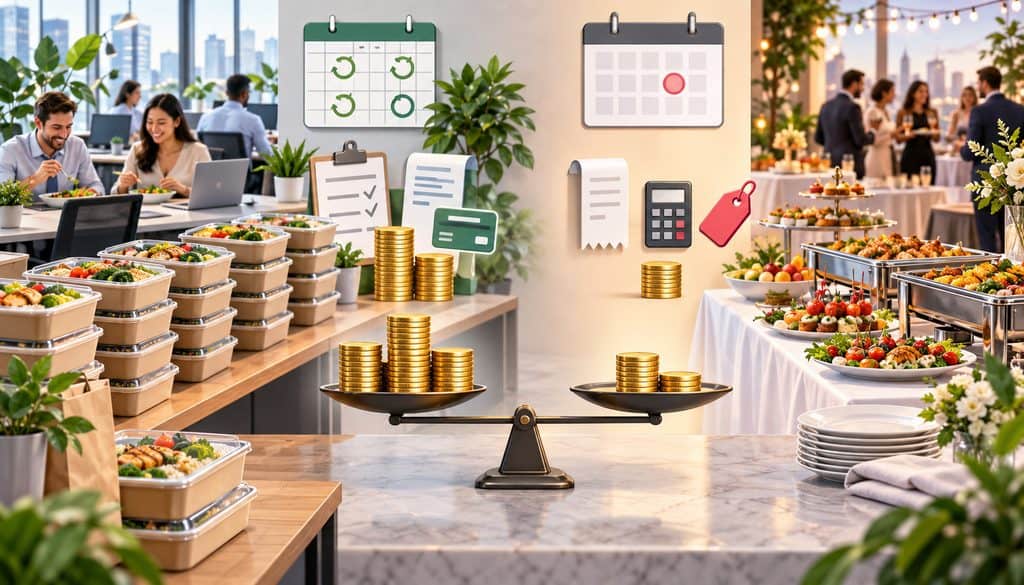
One of the first questions companies ask is whether recurring lunches cost less.
Sometimes recurring volume creates efficiencies. It should not be assumed that every standing customer receives a discount.
Recurring pricing can be structured several ways:
- per-person pricing,
- fixed menu or package pricing,
- a minimum order requirement,
- a delivery charge,
- tiered menu categories,
- separately priced add-ons,
- or custom recurring pricing based on the program.
The caterer may also distinguish between simple drop-off, buffet setup, individually packaged meals, staffed service, and special-event catering.
That distinction matters because food is only part of the cost.
A lunch for 40 people placed in trays at reception is operationally different from a 40-person meal requiring parking coordination, elevator transport, buffet setup, disposable service ware, beverage stations, cleanup, and a staff member remaining on-site.
Does recurring volume lower the price?
Potentially—but not automatically.
Higher recurring volume may create room for pricing or delivery efficiencies, depending on the caterer.
Predictable weekly orders can make purchasing more efficient. A consistent delivery day may make routing easier. Repeating a menu framework can reduce planning friction. A caterer may be able to prepare recurring accounts more efficiently than an unpredictable stream of unique orders.
However, actual pricing still depends on variables such as:
- food selection,
- headcount,
- delivery distance,
- packaging,
- service level,
- labor,
- seasonal ingredient cost,
- dietary customization,
- and order minimums.
That is why the correct question is not simply, “What discount do we get?”
Ask instead:
“What changes in pricing or delivery economics if we commit to a predictable recurring schedule?”
Volume versus reliability
Consistency can be as operationally valuable as raw size.
A dependable 40-person lunch every Wednesday may be easier to plan than an account that orders 80 meals one week, nothing for three weeks, then requests 65 meals on short notice.
That does not mean the smaller order is automatically cheaper. It means predictability has operational value.
When discussing a corporate catering standing order, give the caterer an honest forecast:
- expected normal attendance,
- likely low weeks,
- likely high weeks,
- seasonal office changes,
- remote-work patterns,
- and major meeting months.
That information gives both sides a much better foundation than an inflated promise of future volume.
Establish a budget band, not just a favorite menu
Recurring programs benefit from a budget range.
Suppose the office wants its normal lunch to remain within an approved per-person budget. The menu rotation can then be designed around that range while premium lunches—an executive meeting, recruiting day, client presentation, or annual celebration—are handled separately.
This avoids turning every menu change into a budget exception.
It also gives the caterer room to design variety without accidentally moving the office from an ordinary lunch into a much more expensive service format.
Menu rotation: predictable without becoming repetitive
A rotation might be four weeks, six weeks, seasonal, or flexible. There is no universal schedule.
The useful part is having a structure.
For example:
- Week A: individual lunches,
- Week B: hot buffet,
- Week C: bowls or build-your-own format,
- Week D: sandwiches, salads, and sides.
The next cycle might substitute seasonal items or employee favorites.
Before finalizing the rotation, consider how the food will actually be served once it reaches the office. Matching the catering style to the group size, meal format, dietary needs, and available space can help determine whether individually packaged meals, shared trays, or buffet-style service will work better from week to week.
Weekly Team Lunch Catering Setup: Headcount, Menus, and Cutoff Times

A successful weekly team lunch catering setup is mostly about deciding who controls each moving part and when changes become final.
A practical setup sequence looks like this:
- Choose the recurring lunch day.
- Set a baseline headcount.
- Select the normal service style.
- Build a menu rotation.
- Define how dietary needs are submitted.
- Agree on the weekly cutoff.
- Choose the billing method.
- Run a short trial.
- Adjust the process.
- Activate the regular schedule.
The baseline count should represent a normal week rather than the building’s theoretical maximum capacity.
If 72 people technically work in the office but only 38 to 46 are usually present on Wednesdays, using 72 as the baseline defeats the purpose of the process.
Corporate Catering Headcount Changes and Dietary Requests
Corporate catering headcount changes are one of the most important parts of any recurring lunch arrangement.
The office needs both a baseline and an update process.
For example, the standing count might be 40 unless the coordinator submits a different figure by the agreed deadline. Another office might provide a fresh count every week while using the standing order only for the day, menu framework, delivery details, and billing.
Either approach can work.
What creates trouble is leaving the method undefined.
A weekly update might contain:
- total headcount: 43,
- vegetarian: 5,
- vegan: 2,
- individually packaged allergy-related meals: 2,
- delivery location: Conference Room B,
- approved add-on: beverages.
The exact cutoff should come from the caterer because prep schedules differ.
Do not assume that every caterer needs two days, 24 hours, or any other fixed amount of notice.
The cutoff exists because ingredients need to be purchased or allocated, food must be prepared, employees must be scheduled, labels may need to be created, delivery routes may already be planned, and the kitchen has other orders competing for production capacity.
Pro Tip: Treat the cutoff as a production deadline rather than an administrative preference. Once purchasing, prep, or routing is underway, even a small-looking request may be harder to accommodate.
Use one channel for weekly updates
A weekly team lunch catering setup becomes much easier when the office and caterer agree on one source of truth.
That might be:
- an email thread,
- a catering portal,
- a shared form,
- or another agreed ordering channel.
The important issue is not which technology is used.
It is that the official count can be identified later.
Suppose an employee texts “add three people” while the office manager separately emails a reduction of five. If nobody knows which message controlled the order, the disagreement can carry all the way into the invoice.
One designated coordinator avoids that problem.
Before-cutoff and after-cutoff changes
The exact result of a late request depends on the caterer, menu, and production stage, but this framework is useful:
| Change | Before Cutoff | After Cutoff | What to Confirm |
| Increase headcount | Usually easier to accommodate | Subject to food and production capacity | Whether additional meals are available |
| Decrease headcount | May allow order reduction | Full reduction may no longer be possible | Which count will be billed |
| Dietary request | Easier to plan correctly | Options may be limited | Available substitute and handling |
| Delivery-time change | Often easier to coordinate | May depend on route | Revised arrival window |
| Add drinks/desserts | Can be added if available | Subject to stock and route capacity | Price and approval |
| Skip lunch | Depends on agreed notice rule | Cancellation terms may apply | Whether order is already committed |
The table is intentionally qualified.
“Before cutoff” does not guarantee every change can be made, and “after cutoff” does not mean every change will be rejected.
What is a guaranteed count?
For recurring office lunches, “guaranteed count” generally means the final number the caterer is expected to prepare once the agreed change period has closed.
It does not need to operate exactly like a wedding guarantee.
A recurring program may have a baseline count followed by a weekly adjustment. Once the cutoff passes, that revised figure becomes the production count under the parties’ arrangement.
The office should ask a simple question:
“If we reduce from 44 to 39 before the cutoff, is 39 the billable count? What happens if we send that reduction after the cutoff?”
Knowing the answer before the first delivery is better than debating it on the third invoice.
Handling dietary needs without losing track
Vegetarian, vegan, gluten-free, and allergy-related requests should not be combined into one vague note labeled “special meals.”
Track them separately.
An office might send:
- 4 vegetarian,
- 2 vegan,
- 2 gluten-free requests,
- 1 documented peanut-allergy request.
Those categories are not interchangeable.
Dietary planning is easier when those requirements are collected before menu quantities are finalized. Building guest count and dietary needs into the catering plan from the beginning gives the caterer more time to separate meal types, prepare labels, and identify requests that need additional discussion.
For allergy-related meals, offices should communicate the specific allergen rather than relying only on broad labels such as “special diet.”
The FDA notes that major food allergens require careful identification and that allergen cross-contact can occur when an allergen is unintentionally introduced into another food during preparation or handling. See the FDA’s food allergy and allergen cross-contact guidance for additional background.
The FDA distinguishes ingredient allergen labeling from the broader cross-contact considerations that arise during food production, and most food served directly by restaurants or food-service establishments is not subject to the same packaged-food labeling framework. .
For office coordinators, the operational lesson is straightforward: communicate the actual restriction accurately rather than making assumptions.
Use named meals, labels, and one coordinator whenever possible.
Pro Tip: Keep dietary counts separate from total headcount. “Forty people, including five special meals” is much more useful when the five are identified by category.
Building access belongs in the standing order
Food can arrive at the building on time and still reach the conference room late.
For recurring deliveries, document:
- street entrance,
- loading dock instructions,
- parking limitations,
- receptionist or security procedure,
- badge requirements,
- elevator access,
- floor number,
- setup location,
- and on-site contact.
Greenville-area offices in secured buildings should test this during the first delivery rather than assuming the driver can repeat the process easily later.
Drop-off, setup, and staffed service are different products
A recurring lunch might mean:
Drop-off: Food is delivered to an agreed point and the office handles distribution.
Buffet setup: The catering team places food, serving ware, labels, and related items in the designated area.
Staffed service: Personnel remain to serve, replenish, clear, or manage the meal.
The serving method should also fit the room and the way employees move through lunch. A buffet, individually portioned meal, or other catering service style can create very different space, staffing, and timing requirements, so the format should be settled before the recurring schedule begins.
Catering House Account Net 30: Who Qualifies and How It Works

A catering house account Net 30 arrangement is not simply permission to “pay later.”
A house account is an approved business receivable or credit relationship. The caterer provides the agreed service, records the charges, sends an invoice, and the customer pays according to the approved payment terms.
Those terms might be due on receipt, Net 15, Net 30, prepayment, or another arrangement.
Net 30 means payment is due 30 days after the invoice date or other defined starting point specified by the agreement. It does not mean every recurring customer receives 30 days, and it does not mean a customer can delay payment indefinitely.
Who qualifies for a house account?
There is no universal test.
Depending on the caterer, the application process may consider factors such as:
- legal business identity,
- billing address,
- recurring order history,
- expected account volume,
- AP contact,
- payment references,
- credit information,
- requested terms,
- and anticipated outstanding balance.
The caterer may also establish an account limit.
An office should therefore ask whether a catering house account Net 30 arrangement is available rather than building its workflow around the assumption that it will be approved.
First-party workplace catering platforms illustrate how corporate accounts can support centralized billing and company-specific controls. For example, ezCater currently describes enterprise features that include invoicing, purchase-order or cost-center fields, and centralized corporate ordering. .
That does not establish terms for a local caterer. It does show why business accounts often require more structure than an ordinary checkout transaction.
A house account is trade credit, not an open-ended tab
This distinction matters.
If an office places four weekly lunches before the first monthly invoice has been paid, the caterer may already be carrying several weeks of receivables.
That exposure increases when the program grows.
An account may therefore have:
- approved payment terms,
- a credit limit,
- invoice requirements,
- and rules for overdue balances.
If invoices become significantly overdue, the caterer may send reminders, review the account, place future orders on hold, or require card/prepayment until the balance is resolved.
The exact response depends on the agreement.
Pro Tip: Treat the house account as short-term business credit. Document the terms, billing contact, invoice frequency, and any account limit before recurring service begins.
Set up billing contacts before the first lunch
At minimum, collect and confirm:
- office coordinator,
- backup coordinator,
- AP contact,
- invoice email,
- purchasing contact if applicable,
- PO requirement,
- cost center or department code,
- and escalation contact.
This avoids the common situation where food arrives successfully for a month but the first invoice is rejected because nobody provided a PO number.
Purchase orders and cost centers
Some organizations require a purchase order before any service is delivered.
Others issue one recurring PO covering a month, quarter, department, or approved budget. Another organization may require a unique PO per delivery.
The caterer cannot determine the company’s internal procurement policy.
The office coordinator should confirm the rule with finance before activating the standing order.
Large-company catering programs sometimes support the same controls that AP teams use with other vendors, including consolidated invoicing, purchase-order numbers, cost centers, and department-specific fields.
As one current first-party example, ezCater Enterprise supports invoicing and custom checkout fields for PO numbers and cost centers, illustrating how those controls can be incorporated into a workplace catering account.
The same applies to cost centers.
One company might pay for Wednesday lunches from an employee-engagement budget. Another might split costs among engineering, sales, HR, and executive meetings.
If department coding matters, ask whether it can appear on each order record and the consolidated invoice.
Recurring Corporate Catering Invoicing: One Monthly Bill Instead of Weekly Payments
Recurring corporate catering invoicing is useful when a business wants recurring meals but does not want an employee submitting a separate card receipt every week.
The general flow is:
weekly delivery
→ order recorded
→ approved changes recorded
→ credits or corrections logged
→ billing period closes
→ consolidated invoice produced
→ AP reconciles and pays.
That process sounds simple, but the quality of the weekly records determines whether the monthly invoice is actually easy to approve.
A well-designed invoice should let AP see what happened without asking the office manager to reconstruct four weeks of lunch from email.
What should appear on a consolidated invoice?
Useful fields include:
- invoice number,
- billing period,
- individual delivery dates,
- order description,
- headcount or quantity,
- department,
- subtotal,
- delivery or service charges,
- taxes where applicable,
- approved credits,
- prior balance where appropriate,
- amount due,
- due date,
- PO number,
- and cost-center reference.
Actual tax treatment depends on jurisdiction and transaction details, so the article does not assume a particular tax result.
Illustrative monthly invoice
The following amounts are examples only and are not intended to represent local catering prices or fees.
| Date | Lunch / Department | Headcount | Food Charges* | Delivery* | Tax* | Illustrative Total* |
| Oct. 7 | Wednesday Team Lunch / Operations | 40 | $600 | $35 | $0 | $635 |
| Oct. 14 | Team Lunch / Operations | 44 | $660 | $35 | $0 | $695 |
| Oct. 21 | Team Lunch / Operations | 38 | $570 | $35 | $0 | $605 |
| Oct. 28 | Team Lunch / Operations | 42 | $630 | $35 | $0 | $665 |
| Illustrative billing-period total | $2,600 |
*Illustrative numbers only. Real pricing, fees, and taxes depend on the caterer, menu, jurisdiction, and agreed terms.
The point is not the dollar amount.
It is that each delivery remains visible inside the monthly bill.
Monthly invoice anatomy
| Field | Example | Why AP Needs It |
| Invoice number | INV-1048 | Tracking and payment reference |
| Billing period | Oct. 1–31 | Defines covered period |
| Delivery date | Oct. 14 | Matches order records |
| Department | Operations | Cost allocation |
| Headcount | 44 | Confirms weekly quantity |
| Order description | Buffet lunch | Identifies purchase |
| PO number | PO-XXXX | Procurement match |
| Cost center | CC-XXXX | Accounting allocation |
| Credit | Missing beverage adjustment | Explains reduction |
| Amount due | Consolidated balance | Payment amount |
| Due date | Per approved terms | Defines payment deadline |
This is where recurring corporate catering invoicing becomes genuinely useful: one payment can still preserve the detail behind every delivery.
Invoice date versus delivery date
One monthly bill may include food delivered on several different dates.
The due date therefore should not be guessed from the oldest lunch or the newest lunch.
Payment timing depends on the invoice and account terms.
If the agreement says Net 30 from the invoice date, that starting point should be clear. If terms use another definition, that should be documented instead.
Credits and adjustments
Suppose a dessert tray was omitted and the caterer approves a credit.
The best record is not an informal promise that “we’ll remember next month.”
The credit should be traceable.
It might appear:
- against the affected delivery,
- as a separate credit line,
- or on a credit memo referenced by the invoice.
Traceable credits make reconciliation easier for both parties.
A practical invoice-dispute workflow
If something does not look right:
- Identify the specific delivery date.
- Compare the invoice with the order confirmation.
- Check the weekly headcount update.
- Review any after-cutoff change.
- Confirm add-ons and delivery changes.
- Ask for a correction or credit if appropriate.
- Keep the final adjustment with the account records.
This is much more productive than disputing the entire monthly balance because one line looks unfamiliar.
Card-on-File vs Invoice Billing for Office Lunch Programs
Not every recurring lunch program needs trade credit.
For many smaller teams, card payment is easier. Larger organizations may prefer invoicing because it fits procurement and accounting controls.
Neither method is inherently superior.
| Method | Best Fit | Advantages | Trade-Off |
| Card on file | Smaller teams or simple finance process | Less paperwork; quick settlement | Requires authorized stored-card process and card reconciliation |
| Due-on-receipt invoice | Companies wanting invoice documentation without extended terms | Clear AP record | Still requires prompt invoice processing |
| House account / Net terms | Approved businesses with structured AP | Consolidated billing and procurement controls | Approval and credit management required |
| ACH invoice payment | Larger invoice balances or bank-based AP workflows | Works with centralized AP | Authorization and processing timing differ from card payments |
| Prepayment | New accounts or simple one-off control | No receivable balance | Less convenient for frequent changes |
When card on file is usually simpler
Card payment can work well when:
- the team is relatively small,
- one authorized person manages food,
- there is little procurement bureaucracy,
- weekly receipt reconciliation is acceptable,
- and the company does not need a formal accounts-payable cycle.
A card can also be useful during the trial period before a house account is approved.
However, the office should not simply email card details and assume the caterer can reuse them indefinitely.
A stored card should be handled through an authorized credential-on-file process rather than informal storage of card details.
Current Visa rules require merchants using stored credentials to disclose how the credential will be used, obtain the cardholder’s consent, and communicate applicable terms for future transactions. The Visa stored-credential requirements provide the network framework.
When a payment credential is stored for future merchant-initiated transactions, card-network rules require the stored-credential relationship to be established appropriately. Visa’s current rules, for example, describe cardholder agreement and specific processing requirements for stored credentials and recurring or merchant-initiated transactions. .
Operationally, the office should expect clear authorization for storing and using the card, an agreed billing schedule, and secure tokenized handling through the caterer’s payment system rather than informal storage of raw card information.
Why larger companies often prefer invoice billing
Companies with formal purchasing controls may need:
- PO approval,
- department coding,
- multiple approvers,
- receiving records,
- centralized AP,
- vendor onboarding,
- and an audit trail.
Paying every Wednesday by card can create more work than it removes.
In those environments, a catering house account Net 30 arrangement—or another approved invoicing term—may fit the finance process better.
The key phrase is “approved.”
The office should complete whatever vendor or credit setup is required before assuming the first month can be billed later.
ACH payment
ACH can work well for consolidated invoices, particularly where AP already pays vendors from a bank account.
ACH timing and authorization are different from card payments, so both sides should agree on:
- the payment method,
- who initiates it,
- remittance information,
- invoice reference,
- and how payment will be matched.
An office should not assume that selecting invoice billing automatically means ACH, just as it should not assume every invoice account receives Net terms.
Authorized requesters and approval limits
Payment controls should extend to ordering controls.
A company can name:
- one primary requester,
- one backup requester,
- and a separate approver for unusual additions.
For example, the office manager may have authority to adjust the ordinary weekly count, while adding a large executive meeting or premium dessert package requires department approval.
That is an internal company decision, not a universal catering rule.
It simply prevents surprise charges from requests made by employees who were never authorized to change the account.
Pro Tip: If PO numbers, department codes, or cost centers are required, build them into the standing-order process before the first recurring invoice instead of reconstructing them at month-end.
Holidays, Office Closures, and Pausing a Standing Order
A recurring lunch is not self-canceling.
If the office normally receives lunch every Wednesday and the building closes on a Wednesday holiday, the office should not assume the order disappears unless the agreed pause policy says that it does.
The corporate catering standing order should therefore include a simple calendar rule.
Build a holiday calendar
At the beginning of the program—and periodically afterward—identify:
- known company holidays,
- office shutdowns,
- early-closing days,
- all-hands events replacing normal lunch,
- remote-work weeks,
- training days,
- and rescheduled meals.
This is particularly helpful around year-end periods when several consecutive weeks may operate differently from the normal pattern.
Pause and cancel are not the same thing
A pause temporarily skips recurring service.
A cancellation ends the standing program.
That distinction should be explicit.
An office might pause lunches for two weeks during a company shutdown and then automatically resume on the next scheduled date. A cancellation means future dates should no longer be assumed.
Holiday and pause planning
| Situation | Action | Notice Needed | Billing Impact |
| Known holiday | Mark as skipped or rescheduled | Follow agreed pause deadline | Depends on whether cancellation occurred before cutoff |
| Company shutdown | Pause affected dates | Notify caterer in advance | No automatic assumption; follow agreement |
| Remote-work week | Reduce count or pause | Before weekly cutoff where possible | Based on final accepted order |
| Special company event | Replace ordinary lunch if desired | Coordinate menu/date change | May be priced separately |
| Weather closure | Contact caterer promptly | Follow weather communication process | Depends on preparation and agreed policy |
| Forgotten pause | Contact immediately | May be after cutoff | Cancellation terms may apply |
The “billing impact” column deliberately avoids promising a refund.
Whether charges remain depends on timing, food already committed, and the cancellation terms governing the account.
What if the office forgets to pause?
Imagine a normal Wednesday lunch for 42 employees, but the company announces an off-site retreat.
If the coordinator remembers after the caterer has purchased ingredients or begun preparation, the office may not be able to cancel without cost.
That is why recurring calendars are important.
The recurring order should appear on the internal office calendar just like a meeting.
Weather closures need their own process
Bad-weather decisions may differ between the office and caterer.
The office might close because employees are working remotely while roads are still suitable for delivery. Or the building may remain open while the caterer changes routes because of travel conditions.
The agreement should identify:
- who communicates the decision,
- how quickly the parties will update each other,
- and what happens when preparation has already started.
Do not rely on assumptions about automatic refunds or automatic cancellation.
Remote-work weeks
Hybrid attendance can cause substantial corporate catering headcount changes.
If 45 employees usually attend Wednesday lunch but only 18 will be onsite during a school-break or remote-work week, reducing the count before the cutoff may be appropriate.
If the remaining order falls below a caterer’s minimum, the office may instead need to pause, select another package, or accept the applicable minimum.
That is another reason to confirm minimum-order rules during setup.
Why a Two-Week Trial Is Worth Doing First
A corporate catering standing order looks straightforward on paper.
Then the first lunch arrives and reality supplies the missing information.
The driver discovers that visitor parking is across the property. The elevator requires a badge. Six people who RSVP “yes” are working from home. Employees prefer individual boxes to the buffet. Three dietary meals need clearer labels. AP wants the cost center printed directly on the invoice.
A two-week trial exposes those details before they become recurring problems.
What Week 1 should test
The first week should be deliberately simple.
Use:
- the baseline headcount,
- a representative menu,
- the intended delivery window,
- the normal service style,
- the designated office contact,
- and the proposed billing method.
Observe what actually happens.
Did the food reach the room at the right time? Was security access easy? Were serving utensils available? Did the buffet occupy too much space? Were boxed meals easier than expected? Was there excessive leftover food?
After the first delivery, compare the amount ordered with the number of people who actually ate. Accurate headcount planning helps balance food availability, budget, portioning, and avoidable leftovers, but recurring office lunches should use their own attendance history rather than relying only on general event formulas.
What Week 2 should test
The second week should test controlled changes.
For example:
- increase or decrease headcount,
- add a vegetarian meal,
- submit a dietary update,
- change one menu item,
- confirm a department code,
- or test how the weekly update is acknowledged.
The goal is not to make the second lunch artificially complicated.
It is to confirm that the process works when something changes—because eventually something will.
Trial scorecard
| Metric | Week 1 | Week 2 | Adjustment |
| Delivery timing | Record actual arrival | Compare consistency | Adjust delivery window if needed |
| Headcount accuracy | Note leftovers/shortage | Test revised count | Reset baseline |
| Menu fit | Gather employee feedback | Try adjusted menu | Refine rotation |
| Dietary accuracy | Check meals and labels | Test updated requests | Improve submission format |
| Building access | Note delays | Confirm revised instructions | Add access notes |
| Billing | Review receipt/invoice | Test coding or adjustment | Change AP fields |
| Communication | Note unclear handoffs | Test formal update channel | Confirm single source of truth |
There is no universal numeric threshold for “success.”
Ask whether the process is predictable enough to repeat.
Pro Tip: Run the trial using real office conditions rather than an artificially easy week. Actual late RSVPs, leftovers, access delays, and AP requirements provide the information needed to design the long-term program.
Review after the trial
After Week 2, the office and caterer should review:
- realistic baseline count,
- preferred menu structure,
- delivery window,
- packaging,
- dietary communication,
- cutoff timing,
- ordering contacts,
- billing method,
- and holiday process.
Only then does the weekly team lunch catering setup become a true recurring routine.
Common Office Lunch Program Mistakes
Most recurring catering problems do not begin with the food.
They begin with an undefined process.
| Mistake | Problem | Better Approach |
| No baseline headcount | Every week starts with guesswork | Set a normal count and update it |
| Multiple people change the order | Conflicting instructions | Name one primary and one backup |
| No agreed cutoff | Last-minute changes become disputes | Document the change deadline |
| Vague dietary notes | Caterer cannot identify requirements | Separate vegetarian, vegan, gluten-free, and allergy-related requests |
| Assuming Net 30 | AP expects credit that was never approved | Confirm account terms first |
| Missing holiday pause | Food may still be prepared | Maintain recurring pause calendar |
| Informally storing card data | Payment process may not meet network requirements | Use authorized secure stored-credential process |
| Missing PO or cost center | AP may reject invoice | Supply required billing references upfront |
| Skipping a trial | Operational problems repeat immediately | Test two lunches first |
| Disputing invoice from memory | Weekly changes are difficult to reconstruct | Compare invoice with confirmations |
Mistake: letting everybody be an authorized requester
A department head might ask for 10 extra meals for visitors.
An employee might request desserts.
Someone from another floor might ask the driver to leave half the food elsewhere.
Any of those requests could be reasonable, but they should be approved through the account structure.
A recurring program becomes much easier to reconcile when the caterer knows whose instructions are authorized.
Mistake: treating recurring catering like a fixed subscription
The opposite problem also occurs.
The office assumes that because the lunch is recurring, nobody needs to communicate anymore.
Then the building closes, attendance drops, or a department meeting changes location.
Standing service still requires weekly oversight.
The advantage is that oversight becomes small and predictable.
Mistake: ignoring invoice detail until month-end
Recurring corporate catering invoicing works best when the office reviews weekly confirmations as they occur.
If the October 14 lunch increased from 38 to 46 people, keep that confirmation.
If an approved credit belongs to October 21, keep that record.
AP should not have to reconstruct everything four weeks later.
Mistake: expanding without reviewing the arrangement
A program that worked for 20 people may need different packaging, delivery timing, and billing controls at 50.
Similarly, moving from one office to several locations changes the program.
Each site may need its own:
- address,
- delivery instructions,
- contact,
- headcount process,
- department code,
- and cutoff.
If supported, one master account may still consolidate the billing.
Before scaling, confirm the caterer’s delivery capacity and revisit account terms.
Corporate Catering Standing Order Checklist
Use this checklist before turning the trial into a recurring schedule.
- Estimate normal weekly headcount.
- Choose the normal lunch day.
- Select a realistic delivery window.
- Establish the normal budget per person.
- Choose drop-off, buffet setup, individual packaging, or staffed service.
- Create the initial menu rotation.
- Decide how vegetarian meals are counted.
- Decide how vegan meals are counted.
- Decide how gluten-free requests are recorded.
- Establish the process for allergy-related requests.
- Designate the primary office contact.
- Designate a backup contact.
- Agree on the headcount cutoff.
- Define how increases are requested.
- Define how decreases are requested.
- Confirm what happens to post-cutoff changes.
- Confirm any minimum order.
- Confirm delivery or setup charges.
- Decide between card payment and invoice billing.
- Apply for a house account if needed.
- Confirm approved payment terms rather than assuming Net 30.
- Supply the AP contact.
- Supply invoice email address.
- Provide PO requirements.
- Provide cost-center or department fields.
- Confirm invoice frequency.
- Confirm payment method.
- Build the holiday calendar.
- Identify known skipped weeks.
- Define pause notice.
- Define cancellation process.
- Document weather-closure communication.
- Define authorized add-on requesters.
- Run a two-week trial.
- Review leftovers and shortages.
- Review delivery timing.
- Review building access.
- Review dietary accuracy.
- Review labels and packaging.
- Review invoice detail.
- Adjust the baseline count.
- Adjust menu rotation if needed.
- Confirm the recurring schedule.
- Submit weekly changes through the agreed channel.
- Reconcile monthly invoices against delivery records.
- Review the program periodically.
Questions to ask the caterer before setup
- Do you support recurring weekly standing orders?
- Is recurring pricing structured differently from one-off orders?
- Is there a weekly minimum order?
- When is the headcount update due?
- How are increases handled?
- How are decreases handled?
- What happens if a change arrives after the cutoff?
- How should dietary requests be submitted?
- Can we use a rotating menu?
- What delivery window should we plan for?
- Can we pause specific holiday weeks?
- What notice is required to skip a lunch?
- Do you offer approved house accounts?
- What is required to obtain invoice terms?
- Is monthly consolidated invoicing available?
- Can invoices include a PO or cost center?
- Can we keep an authorized card on file instead?
- Is ACH available for invoice payment?
- How are credits shown?
- Can we run a two-week trial?
Complete client-side workflow
For teams wanting a repeatable process, the full workflow looks like this:
- Estimate the normal onsite weekly headcount.
- Set the lunch day.
- Set the delivery window.
- Establish the normal per-person budget.
- Choose drop-off versus setup.
- Create a menu rotation.
- Define the dietary-request process.
- Name the primary office contact.
- Name the backup contact.
- Agree on the weekly cutoff.
- Define how corporate catering headcount changes will be submitted.
- Define post-cutoff rules.
- Decide between card on file and a house account.
- Complete a credit application if required.
- Confirm the approved invoice terms.
- Add PO and cost-center information.
- Create the holiday and office-closure calendar.
- Run the first trial lunch.
- Review timing, food quantities, and access.
- Run the second trial with a controlled change.
- Review dietary handling and billing.
- Adjust the process.
- Confirm the corporate catering standing order.
- Submit weekly updates before the cutoff.
- Receive the delivery.
- Confirm the order while the details are fresh.
- Record approved credits or issues.
- Review the consolidated invoice.
- Reconcile it with weekly delivery records.
- Pay according to the approved terms.
- Review the program quarterly or when office patterns materially change.
That workflow looks long because every decision is shown separately.
Once established, most weeks require only one action: confirm the count and any special requests.
Frequently Asked Questions
What is a corporate catering standing order?
A corporate catering standing order is a recurring arrangement in which an office receives catering on a regular schedule using agreed parameters such as the delivery day, expected headcount, menu framework, change deadline, dietary process, and payment method.
It does not necessarily mean identical food or identical attendance every week. The standing structure remains stable while approved variables can change.
Is recurring office lunch catering cheaper than ordering each week?
Not automatically.
Recurring orders can reduce planning, routing, menu-selection, and administrative friction, which may create pricing efficiencies. Actual cost still depends on menu, volume, packaging, service style, delivery requirements, minimum orders, and the caterer’s pricing structure. Ask how recurring consistency affects pricing rather than assuming a discount.
How do I set up a weekly office lunch catering program?
A practical office lunch catering program starts with a normal headcount, recurring day, delivery window, budget range, menu rotation, dietary-request system, change cutoff, office contact, and billing method. Run one or two trial deliveries before locking the arrangement into a longer recurring calendar.
How far in advance do I need to update the headcount?
The caterer should provide the applicable cutoff.
There is no universal headcount deadline because purchasing and prep requirements vary by menu, service format, delivery schedule, and kitchen capacity.
What happens if our headcount changes after the cutoff?
Late corporate catering headcount changes may still be possible, but they become subject to capacity. An increase might depend on available food. A late decrease may not fully reduce the bill if ingredients or preparation have already been committed. Confirm the rule when setting up the account.
How should dietary restrictions be communicated?
Use one coordinator and separate the request types.
For example, identify the number of vegetarian, vegan, gluten-free, and allergy-related meals instead of writing “six special meals.” For allergy-related requests, communicate the specific concern and ask the caterer what handling or cross-contact controls it can support.
What is a catering house account?
A house account is an approved B2B receivable or credit account.
The office receives service and then pays according to the agreed invoice terms. It should be treated as short-term trade credit, not an unlimited running tab.
Does every company qualify for Net 30 catering terms?
No.
A catering house account Net 30 arrangement may require application and approval, and some caterers may offer different terms or require card payment, prepayment, or due-on-receipt invoices. Never build the program around Net 30 until the actual terms have been approved.
How does recurring corporate catering invoicing work?
With recurring corporate catering invoicing, each delivery is recorded during the billing period and then presented on one consolidated invoice or account statement. Ideally, the invoice retains delivery dates, order descriptions, departments, charges, credits, PO references, and the applicable due date.
Can we receive one invoice for the entire month?
Possibly.
Some corporate catering arrangements support consolidated monthly billing, while others invoice per delivery or use another billing cycle. Confirm the invoice frequency before starting the program.
Is card-on-file better than invoice billing?
It depends on the company.
Smaller organizations often value the lower administrative burden of an authorized card on file. Larger businesses may need house-account invoicing because their AP processes require POs, department coding, approvals, and consolidated reporting.
Can we pay monthly catering invoices by ACH?
If the caterer supports it.
ACH can be useful for business invoices, but the payment process, authorization, and timing should be agreed in advance. Do not assume invoice billing automatically includes ACH.
What happens to the standing order on holidays?
Follow the agreed holiday-pause rule.
A recurring order should not be assumed to disappear automatically because the office is closed. Put known holidays and shutdown dates into the program calendar and communicate changes before the applicable cutoff.
Can we pause the program for a week?
Usually a recurring arrangement can be designed to accommodate temporary skipped weeks, subject to the caterer’s notice and cancellation rules. Make sure everyone distinguishes a pause from cancellation. A pause skips certain service dates; cancellation ends the recurring arrangement.
Should we run a two-week trial before committing?
For many offices, yes.
A two-week trial lets the team test real headcount, delivery timing, building access, packaging, menu acceptance, dietary communication, and billing detail before confirming the corporate catering standing order for a longer period.
Conclusion
Recurring office catering works best when the repeatable decisions are made once and the changing details are managed through a simple weekly process.
Start with a realistic baseline headcount, a practical menu rotation, a standing delivery window, one authorized office coordinator, and a clearly defined change cutoff. That structure prevents every lunch from becoming a new event-planning project.
For larger companies, a house account and consolidated invoice can reduce AP work when purchase orders, cost centers, and formal approvals are involved. Smaller teams may find an authorized card-on-file arrangement easier because it removes much of the invoice administration.
Holiday weeks, remote-work periods, weather closures, and temporary pauses should be planned rather than assumed. The same applies to dietary updates and late headcount changes.
Most importantly, test the arrangement before treating it as permanent. Two real lunches will show whether the delivery window, food quantities, labels, building access, employee preferences, and billing records work under normal office conditions.
When those pieces are standardized, a recurring office lunch stops feeling like an event that must be recreated every week and becomes a manageable part of the workplace calendar.
Leave a Reply